Wildflowers of the National Capital Region
Discovering wildflowers in Maryland, Washington D.C., and Northern Virginia
Identifying Vernonia (ironweed) Species
Ironweeds (genus Vernonia) are tall plants in the Aster family with bright purple flowers. Three species of ironweeds are present in the National Capital Region: Vernonia noveboracensis (New York ironweed), Vernonia glauca (Broadleaf ironweed), and Vernonia gigantea (Tall ironweed). While similar, they can be distinguished by examining the flower heads.
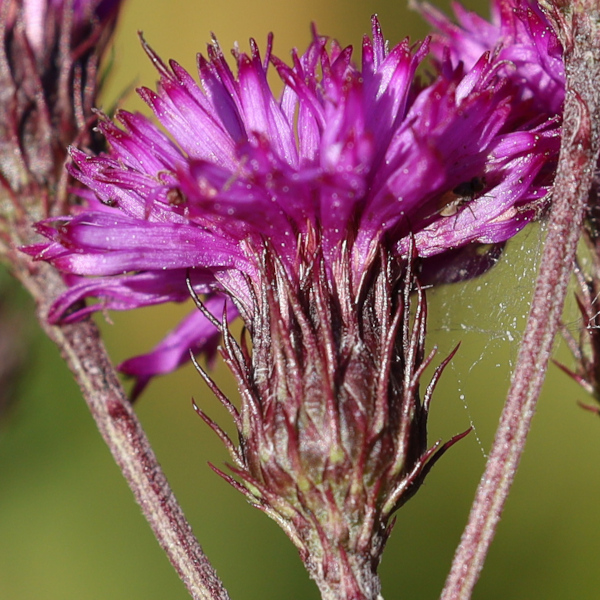
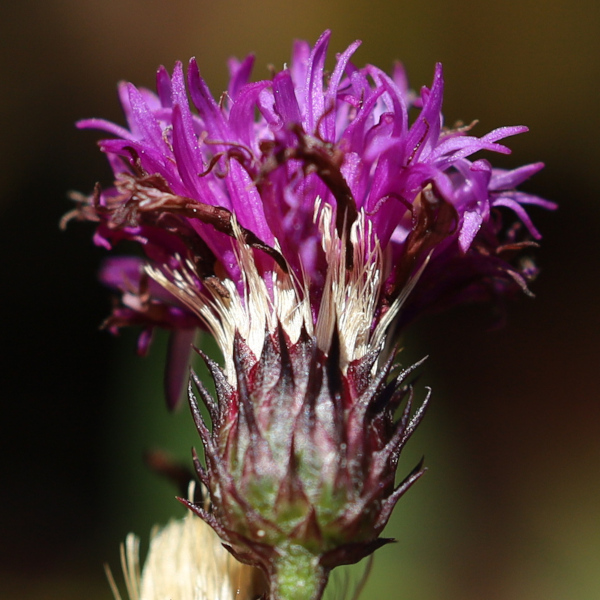
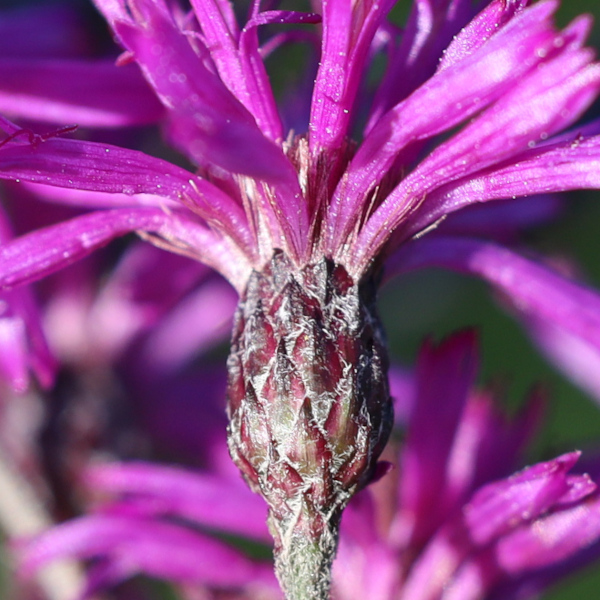
At the base of the flower heads are the phyllaries, a set of bracts which surround the base. The phyllaries of Vernonia noveboracensis and Vernonia glauca end in sharp needle-like or thread-like tips, which bend outwards. Vernonia gigantea can be distinguished from the other two by its phyllaries, which end in acute or blunt tips, and which remain pressed against the surface of the flower head.
To tell apart Vernonia noveboracensis from Vernonia glauca, look at the pappus - the bristle-like hairs which are intermixed with the florets. The pappus of Vernonia noveboracensis is purple-brown, similar in color to the florets. The pappus of Vernonia glauca is much lighter in color, yellowish or sandy colored, which stands out against the darker color of the florets.
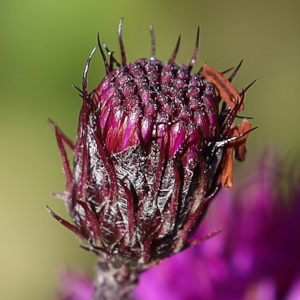
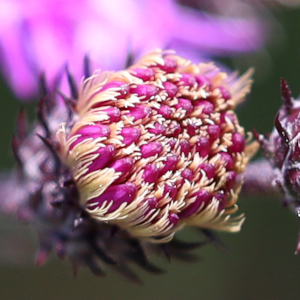
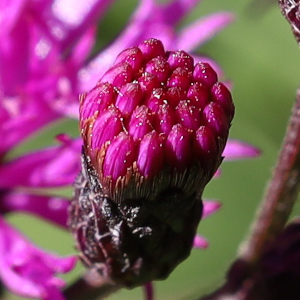
The color difference of the pappus is particularly evident on flower heads that haven't yet opened, as seen above.
In addition to the appearance of the flower heads, there are some other noteworthy differences between the ironweed species. Vernonia noveboracensis has leaves that can be six or more times as long as wide. The length to width ratio of the leaves of Vernonia glauca is much smaller, usually three or four times as long as wide. Vernonia noveboracensis is by far the more common species of the three, and is widespread in the region. Vernonia glauca and Vernonia gigantea are less common, with Vernonia gigantea mostly present in higher elevations.